Is ImLive Safe? Operator, Host Rules, Billing 2026
The short answer
ImLive's pages name an operator, IML S.L.U. of Andorra, and publish terms of use revised July 6 2026, a privacy policy, a 2257 statement and a DMCA notice. Hosts go through ID and live identity steps. In October 2026 the front page loaded 9 third-party domains and redirected nowhere else. Card payments run through CCBill or SegPay, and a guest account closes from a preferences page.
Who stands behind ImLive?
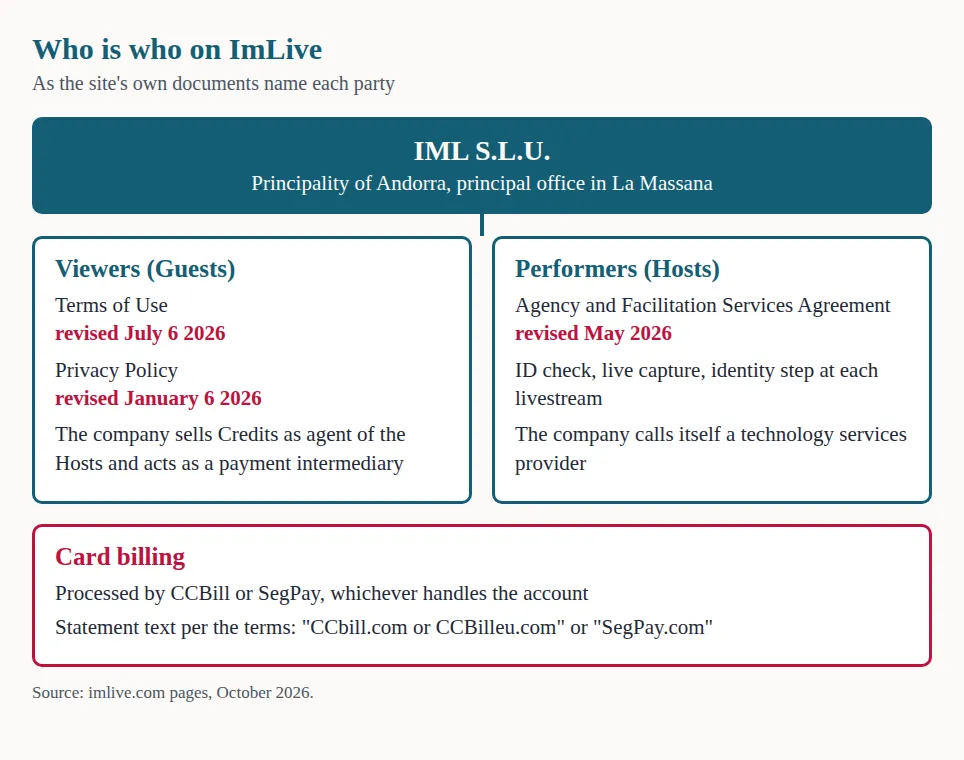
The company behind it is IML S.L.U., and the terms of use say so in the first paragraph: it is "organized under the laws of the Principality of Andorra" with its principal office at St. Antoni 27, La Massana. The 2257 statement uses a different spelling, I.M.L. SLU, and gives the same town. Read it as one company named two ways.
We list ImLive in our biggest sites category, and the listing page covers what the site offers. This post goes into the paperwork behind it. The sign-up strip reads "Sign up for FREE - Women Men Trans", so the site is built around three sets of Hosts.
The company describes its own role in two different ways, depending on which side of the screen you are on. In the terms of use, it makes the site available "at the request of, and in its capacity as the agent of, the Community of Hosts". In the Host agreement, which is titled an "Agency and Facilitation Services Agreement", the Hosts agree that the company "is a technology services provider". The terms add that the company is "acting as a payment intermediary" and is not a party to any arrangement between a viewer and a Host. In plain words: the company runs the platform, sells the credits and deducts a company fee from Host payments, and says the chat itself is between you and the Host.
The page footer says "Celebrating 24 years". In October 2026 the support page claimed more than 62 million registered Members and more than 80,000 Hosts. Those are the site's own claims, and the page gives no source for them.
Which documents does it publish, and how current are they?
It publishes six that matter here, and four of them carry a printed revision date. Dates tell you which wording is in force and how long it has been since anyone updated it.
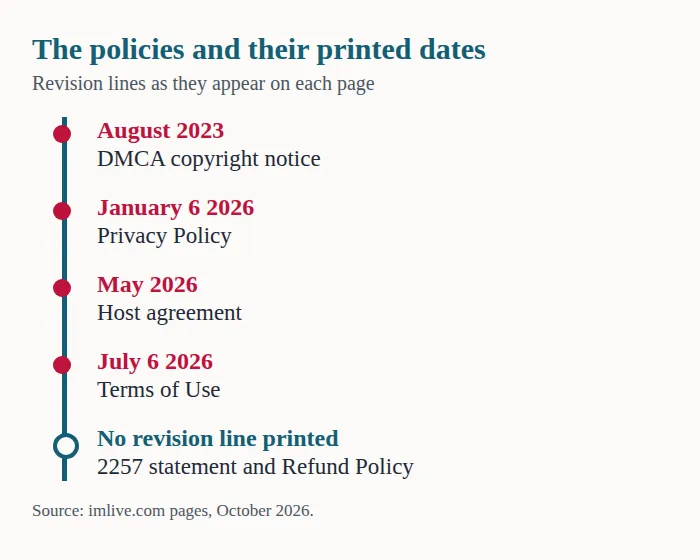
The terms of use were last revised July 6 2026, and they say the company may revise them at any time without notice, with continued use counting as acceptance. The privacy policy carries January 6 2026. The Host agreement says May 2026. The DMCA notice is the oldest, last revised August 2023, and it covers copyright claims. The 2257 statement and the refund policy print no date at all.
The footer also lists a content complaints page, a cookie policy, an anti-spam policy and a TAKE IT DOWN Act policy. Their text is not reproduced here; the footer links to each.
The 2257 statement is the age-records law's notice. It says everyone shown in explicit depictions was 18 or older when they were made, and that the required records are kept at the company's office in La Massana, with the Office Manager responsible for them. It also admits that some depictions may be exempt from that law, for example those that contain no depiction of sexually explicit conduct as the statute defines it.
How does ImLive protect the people on camera?
By its own account, in three layers: an ID and live-capture step before a Host is approved, identity steps during shows, and a list of banned content with a way to report it. Each layer is a claim in the company's own contracts, and none comes with an outside report on how well it works.
Before a Host goes live
The Host agreement opens its age section with a flat sentence: "ImLive verifies the identity and age of every Host." It spells out what that means. The Host, or the owner if the Host is a business, supplies a live capture of their face, their government-issued photo ID front and back, and a picture of themselves holding the ID. The company says the point is "to ensure that individuals are present, are live, and consent to the application process". It names third-party vendors that specialize in validating identity documents, and it says the process is required by US age-records rules and by credit card association rules.
Two more clauses matter. The Host confirms being "a consenting adult who is performing services at your own free will". And if the company learns that a minor is using the platform as a Host, it says it ends the account immediately and without notice.
During a show
This is the part that goes further than a one-time sign-up check. The agreement says ImLive "conducts live monitoring of Host's performances, including a Host verification step at the beginning of each livestream and periodically throughout the livestream". The purpose it gives is to confirm that the persons on the livestream are the persons approved on the Host's account. Hosts consent to this by accepting the agreement.
The gap
The Host FAQ tells would-be Hosts they will supply photo identification for age verification, then adds, in parentheses, "not necessary for all Host categories". The pages do not say which categories those are. The agreement's own wording is "every Host", so the two pages pull in different directions, and neither explains the difference.
What the rules ban
The terms of use list conduct that is off limits. It covers content that "contains fake or manipulated content concerning another person", and sexually explicit material of anyone who has not given "prior, express, and informed consent" to it being taken or shared. It also includes hate aimed at sexual orientation or gender identity, and harassment. On sexual content involving minors the terms state "zero tolerance" and say every instance is reported to the authorities.
Reporting and what follows
The Host agreement says viewers and Hosts have "effective mechanisms" to report prohibited content, and names three: "report button, through the customer service live chat and internal system email". The company says it reviews reported content and, where the content breaks the rules, it may remove it, issue a warning, or suspend the account. It says it notifies the person who reported. It also says it uses "automated, semi-automated tools, or human" review, and in the same breath admits it "may not be able to identify all Prohibited Content".
The terms also follow the EU's online platform law, the DSA. They name a point of contact for these matters. And for people living in the EU they say a certified out-of-court dispute body may be chosen to help settle a disagreement over a decision on a complaint, which the company may decline to work with if the person contacts that body more than six months after the company's decision without first using its complaint process.
Reporting is also guarded in the other direction. Accounts that spread manifestly illegal content can be suspended, and so can accounts that keep filing manifestly unfounded complaints.
What Hosts sign away
For the people on camera, one clause deserves a plain reading. The Host agreement grants the company "a general royalty-free, irrevocable, perpetual, exclusive and worldwide license" to still and video images of a Host and their shows, including recorded sessions, "including providing or selling them to third party sites". In October 2026 the Host FAQ said Hosts can receive "between 27% & 100% of what Members pay", depending on category, what the Host charges, seniority and member ratings, and that each Credit a Host earns pays $1 USD. A performer who later wants a recording gone has the DMCA process for copyright claims, and the agreement's license language to read first.
What does it mean for a paying viewer?
A free account costs nothing, and paying means buying Credits. The terms say the company "does not charge Guests any basic fee", and that Credits, bought for real money or given in a promotion, are what you spend to access content offered by Hosts. The front page offered "UP TO 40 FREE CREDITS" on joining in October 2026.
Credits, and two roles on the bill
Credits are a virtual item under the terms, and three clauses are worth knowing before you buy. They "can never be redeemed or cashed out" for real-world money. They "expire 30 days from the date of purchase or after that shorter period as might be set out in these Terms". And if an account is closed for any reason, any credits left on it expire at once.
The terms name two parties on a card payment. The company sells the Credits, and the card is processed by "one of the Company's third party processors (CCBill and SegPay, etc.)". The page prints what a Visa statement shows, quoted as "CCbill.com or CCBilleu.com" or "SegPay.com", "depending on which company is processing the account". The word "etc." in that list means the pages do not promise those are the only processors, and they name no descriptor for any other. They also name other ways to pay: check, bank wire, prepaid payment through third parties and, where permitted, cryptocurrency through third parties.
Canceling and getting money back
To stop, the terms say you may cancel your guest account "at any time" from the preferences page. The same sentence adds that you stay liable for any payments already due. The refund policy is where the detail is. It says the company may issue credit refunds for technical problems, unsatisfactory paid sessions and unspent purchases made in error, and a card refund for unspent transactions bought within the last 30 days. In October 2026 it also offered a new customer, with a first purchase in the last 30 days, a refund of "up to 25 credits".
The warning to read twice is about going around the company. The page says a refund requested directly from your card company or the billing processors "may result in your account with ImLive.com being terminated with immediate effect", with no new account allowed afterward, and it calls chargebacks "fraudulent". So the page's advice is to contact the company first.
What the privacy policy keeps
The privacy policy says registration takes an email address, a username and a password, and the sign-up form also offers a Google or X login. It says the company also collects uploaded identity documents "to identify customers", and that it holds device details such as unique identifiers, browser fingerprinting, IP address and geo-location data, plus pages viewed, clicks and time spent. Payment details go to the processors, which the policy says the company does not itself access.
On how long, it prints no figure. It says personal information is kept while the account is active, then for further periods to meet obligations under applicable laws, including Know-Your-Customer and anti-money-laundering rules, and for "longer periods" where needed for fraud prevention and record keeping. To delete it you email the data protection address in the policy, and the company says it will "make reasonable efforts to address your request". The policy warns that erasing your data might close the account.
The policy lists who may receive data: affiliated companies, cloud and identity services, payment processors and banks, authorities, and buyers in a sale of the business. It says data may move outside the European Economic Area. It names Microsoft Clarity as an analytics tool, says third-party advertising technology is used with opt-outs through the browser and the industry opt-out pages, and states: "we do not sell your Personal Information." The sign-in box on its pages also asks for a 6-digit code from an authenticator app where two-step verification is on.
The front page in October 2026
In October 2026 the front page loaded 129 requests and 9 third-party domains (amazonaws.com, clarity.ms, google-analytics.com, google.com, googleapis.com, googletagmanager.com, gstatic.com, imlmediahub.com and wlmediahub.com), named no ad network, and sent the visitor nowhere else, with no malicious verdict and no security warning.
What do the pages leave unsaid?
Silence is information, so here is what the pages do not state. No retention period for ID documents or account data. No list of which Host categories skip the photo ID step. No wording for the content complaints page or the TAKE IT DOWN Act policy beyond their names in the footer. No statistics on how many reports were made or acted on. No printed date on the 2257 statement or the refund policy. And no statement descriptor for any processor beyond the two named.
The terms say the company does not guarantee the accuracy, completeness or timeliness of its moderation.
What to do next
If you plan to pay, read the terms of use credit and cancellation clauses and the refund policy first, because the 30-day expiry and the chargeback warning are the two rules with money at stake. Start with the free account and the free credits before putting a card in. Note the statement text to watch for, "CCbill.com or CCBilleu.com" or "SegPay.com", and that it is not guaranteed to be the only one.
If your question is about the performers, the Host agreement is the document to open, in particular the age section and the license clause. If you want to see how the site fits next to others by audience, the biggest sites page has the wider list, and the listing page has the short version. The about page has more on the directory.
Frequently asked questions
Is ImLive safe to pay for with a card?
The terms say card charges are processed by CCBill or SegPay and appear on a statement as "CCbill.com or CCBilleu.com" or "SegPay.com". The refund policy warns that going to your bank or the processor for a refund may close your account for good. Read the refund page before you buy credits.
Does ImLive keep the data I give it?
Its privacy policy says it keeps personal information while an account is active, and longer where the law, anti-money-laundering rules or fraud prevention call for it. No fixed period is printed. You can ask for deletion by email, and the policy warns that deleting your data may close the account.
Can I watch on ImLive without showing my own face?
Yes. The support page says you don't need a webcam, and that you don't need to be seen if you have one and prefer not to use it. A free account takes an email address, a username and a password, or a Google or X login.
How do I report something on ImLive?
The terms name a report button, the live support chat and an internal email system. The company says it reviews reported content and, where it breaks the rules, removes it, warns or suspends the account and tells the person who reported it.
From the blog
All posts
Is Chaturbate Safe? Tokens, Privacy and Leaving in 2026
Follow a Chaturbate viewer from free watching to an account, token purchase and canceling, with what the site's own pages say about billing and data.
Is Dorcel TV Safe? Terms, Billing and Removal in 2026
What Dorcel TV's 2257 notice, removal link, four named payment processors and cancel steps say, plus its October 2026 front-page load.
Is hip.porn Safe? Uploader Rules and Removal in 2026
What hip.porn's pages say about who vouches for the people in a clip, how the report form works, what removal looks like and what a viewer gives up.