Is Chaturbate Safe? Tokens, Privacy and Leaving in 2026
The short answer
Chaturbate publishes terms (last modified January 14, 2026), a privacy policy, a 2257 statement and a consent article. Watching needs no account. Tokens are billed through Chaturbate Direct Billing or Epoch, and the terms let you cancel at any time. Broadcasters submit a live selfie and ID. In October 2026 the front page loaded 4 third-party domains.
Chaturbate in its own documents
The terms name Multi Media, LLC as the company behind the platform and call everyone on it a Community Member. Members who can receive tokens from other members are Independent Broadcasters. The terms say they broadcast "as and when they determine" and set their own rules for people watching. Disputes go to arbitration in Los Angeles County, California. We list the site under biggest porn sites, and the listing page covers the basics.
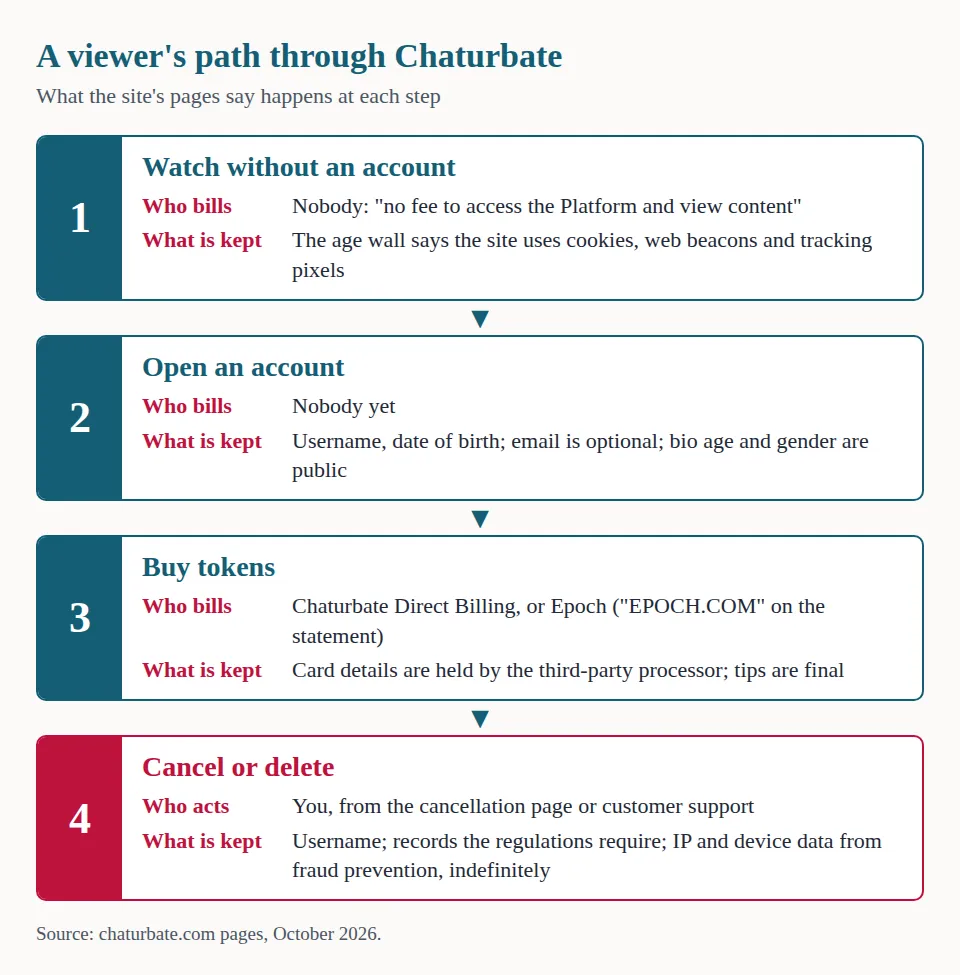
This post is about something narrower: what happens to you, the viewer, at each step. The four steps below follow the order a person meets them, with what each stage says about billing and about what is kept.
Step one: watching without an account
The terms say it plainly: "There is no fee to access the Platform and view content." An account is required only for "some functions." So the first step costs nothing and asks for no sign-up.
It is not a step with no paperwork, though. The age wall in front of the site asks you to affirm, "under oath and penalties of perjury," that you have reached the age of majority where you live, and to click "I Agree." The same wall has you agree that the site uses cookies, web beacons and tracking pixels, that your use is governed by the terms, and that any dispute falls under the personal jurisdiction of California, Los Angeles County. The wall's text describes a declaration. It does not describe a document or selfie check for viewers.
The terms also warn that you may see or receive messages, "solicited and unsolicited," containing graphic depictions of nudity and sexual activity between adults. The age floor is the greater of 18 or the age of majority in your jurisdiction.
The privacy policy fills in what the tracking line means. It lists cookies that remember your choices, cookies that count which pages are popular, and cookies "used to show advertising that is relevant to you based upon your viewing history." It lists your IP address, location of your device, and your interaction with advertisements among the information collected.
In October 2026 the front page loaded 4 third-party domains (google.com, gstatic.com, highwebmedia.com and mmcdn.com) across 275 requests. No ad network was named among them. The load showed no redirect elsewhere, no malicious verdict and no security warning.
Step two: opening an account
Most people open an account for chat, following rooms and tipping. The privacy policy says a general account needs a username and a date of birth, kept "for account access purposes." An email address is optional. The terms say that skipping it limits the support the site can give, because it cannot confirm you are the account holder.
Some of what you enter is public. The privacy policy says the age you show in your bio does not have to be your real one, and that this age, your gender and the genders you want to talk to are public, along with anything else you put on your profile, such as a location or "about me." The policy also says anything you share through chat, messages or tip notes counts as public information "regardless of your use of a password." Its own advice: "we recommend using a unique username not in any way tied to any of your social media accounts or real name."
Two more clauses matter to a viewer. The terms "highly encourage" two-factor authentication, and the privacy policy says that if you attach a phone number to it, the number also goes directly to a third party called Twilio, whose use of it falls outside the policy.
The sign-up asks viewers for a username and a birth date. The ID and selfie requirements are for broadcasters.
Who is on the other side of the screen
That difference is the reason this site's documents read so differently for each side. The people on screen are held to far heavier checks than the person watching.
The terms say anyone who wants to become an Independent Broadcaster must submit a live selfie video and a live video of an unexpired government photo ID. The broadcaster registration page says every member must pass age verification to begin earning tokens, and that payouts go only to members who prove they are 18 or older. The 2257 statement says the operators are not the producers of the broadcasts, and that "Age verification records are collected and reviewed before permitting a Performer to collect virtual funds."
The privacy policy names the vendor: it says the site uses technology from Incode Technologies, Inc. for identity checks, and that a faceprint, a selfie image and data from the ID may be collected. A separate biometric policy within it also mentions a third party called Jumio. It says the selfie is cropped and stored apart from the original ID document and the faceprint, and that the records are held for the period the regulations require. The privacy policy puts that at seven years from the date content was last made available through the account. Broadcasters who wear a mask or show a limited view may get periodic requests for a new selfie, which the site's age team reviews.
On consent, the Safety & Consent article, updated February 10, 2026, says the platform has zero tolerance for human trafficking, sex trafficking and coerced participation, and that a violation brings a permanent ban and a report to law enforcement and NGOs. It names four kinds of consent it will not accept: pressure or promises from a third party, consent given under the influence of alcohol or other intoxicants, consent given under threat to a job, housing or basic necessities, and consent given to avoid harm or intimidation. It bans role-play that simulates trafficking or abuse, and says accounts, uploads and broadcasts are subject to real-time monitoring.
The terms balance that. They say the company has no obligation to monitor member content, and that it relies on notices from third parties. They also say the site reports every suspected minor to the National Center for Missing and Exploited Children, and that its zero-tolerance rule covers adults whose makeup, clothing, room decor or camera filters could leave viewers with the impression they are not of age. If you think you see a case, the terms ask you to alert the site immediately.
For a viewer, these pages explain what stands behind a face on screen: ID and selfie before payment, repeat checks for masked broadcasters, and a written consent policy. They describe real-time monitoring next to a disclaimer of any duty to monitor, and they do not say each broadcast is reviewed before it airs.
Step three: buying tokens
Tokens are how you pay. The terms say members may "put money on deposit" that is converted to tokens, usable for tipping broadcasters or buying items from a broadcaster's bio page. Private shows are priced in tokens too. In October 2026 the private-show menu listed rates from 6 Tokens per Minute to 90+ Tokens per Minute.
Who bills you is on the billing support page. It says to identify the descriptor on your card statement and then lists two billing types. Chaturbate Direct Billing has its own support contacts. Epoch is listed as third-party billing and called "our authorized sales agent," and the page prints that "EPOCH.COM" will appear on your credit card statement. The page prints no descriptor for Direct Billing. The terms add that certain purchases may be processed by UAB Alternative Payments, in Vilnius, Lithuania, "as an EU based purchase facilitator," and the terms print no descriptor for it.
The terms say your payment details are "received and held by a third-party payment processor" that stores them for future use on the platform. The privacy policy adds that what the processor collects is not governed by the site's policy, so the processor's own policy applies.
A few clauses worth knowing before you spend:
- Tips are final. The terms call every token tip a gratuity, "final when sent." If a broadcaster does not do what a tip menu suggests, the terms say you may not legally compel it or insist on a refund, though you can leave feedback once every 30 days.
- You cannot tip for a specific act. The terms prohibit it and say a request or demand may lead to a ban for all parties involved.
- Auto-refill is optional. The terms say the site may offer to repurchase a package when your balance hits a level you set, that you can turn it off in account settings, and that you are notified each time it runs.
- Fan clubs renew monthly. A fan club membership renews and is rebilled monthly until you cancel it. The FAQ has an article titled "How do I cancel a fan club membership?"
- Billing errors have a clock. If you do not tell the site within 30 days after a billing error first appears on your statement, the terms deem the charge accepted.
One effect is visible to others: the privacy policy says buying and tipping tokens, or buying a subscription or fan club membership, may change the color of your username.
Step four: leaving
The terms give you two ways out, and they say you can use either "at any time": you "may terminate your Account and/or any of your memberships ... by visiting our cancellation page or by contacting our customer support." Until you do, you stay "personally liable for any and all charges incurred by your Account." The footer carries Billing and Disable Account links.
Closing the account has consequences the terms spell out. You lose access to the non-public areas and to any member content in your account, and the company has no duty to keep your content or mail, which "may be irretrievable." For money still on deposit, the terms say a non-broadcaster closing an account can withdraw it, subject to third-party processing costs. A separate clause says unused deposits can be withdrawn by contacting customer support, less amounts charged by third parties in the initial and refund transactions.
Deleting is a different request, and the privacy policy treats it differently. It offers a deletion tool, and says personal data will be deleted "in compliance with our data retention policy and applicable law and rules." Then it lists what stays. Your username is retained "to avoid abuse of the Platform and to avoid anyone impersonating you." If your account is restricted when you ask, the restriction may become a permanent ban and minimal records are kept to maintain it. Records the regulations require stay. And if you have tokens, purchases, subscriptions or content when you ask for deletion, the policy says you agree they are forfeited, with no transfer or refund.
Read together, the terms say unused deposit money can be withdrawn when you close the account, while the privacy policy says a deletion request forfeits tokens. The documents give no rule for how the two fit together. If tokens are left, the order matters: the terms point to customer support for a withdrawal.
Some data is not tied to the deletion tool at all. The privacy policy says IP and device data passed to fraud-prevention services "will be retained indefinitely for the protection of the Platform and its users." Contact with the community support team is subject to recording and monitoring, per the terms. And the law enforcement page says the site will disclose requested information on a valid request from law enforcement or a court, while the privacy policy reserves the right to share account information in response to written requests from law enforcement or others.
If you want to see what the site holds before you decide, the privacy policy offers a self-serve tool to review or receive a copy of your personal information.
If you appear in content, or see something that should not be there
Viewers are asked to report, so the route matters. The footer carries links for Safety & Consent, DMCA, Law Enforcement, a report link for abusive content, Billing and "Disable Account." For a member who breaks the terms, the terms say to email support or use the "REPORT ROOM" function on a broadcast window, and that "All reports are reviewed as soon as practicable but in no event more than 4 business days." The terms also describe how a person who appears in content without consent can act: email the support team a link to the content and a statement that you did not consent or are withdrawing consent, and "the content in which you appear will be removed as expeditiously as possible."
Copyright takedowns go through the DMCA process in the terms, and the FAQ has articles on putting a DMCA badge on a stream and on content used on another site. A broadcaster's deletion request has a limit worth knowing: content other members acquired before the request stays in their accounts, per the terms.
What the documents leave open
Silence is a fact you can use.
- The removal route for content you appear in without consent gives no response time, only "as expeditiously as possible."
- The privacy policy gives no retention period for an ordinary viewer's account data and refers to a "data retention policy" by name. The periods it states are seven years for broadcaster age records and "indefinitely" for fraud-prevention data.
- The billing page prints a statement descriptor for Epoch only; none is printed for Direct Billing or the UAB Alternative Payments route.
- How withdrawing a deposit on closing fits with forfeiting tokens on deletion.
What to do next
Decide at which step you want to stop, because the pages put the commitments late: nothing for watching, a username and birth date for an account, and the money questions only at tokens. If you buy, note which billing type the checkout shows and look for "EPOCH.COM" on your statement, since that is the one descriptor the site prints. Turn on two-factor authentication if you open an account, keep the username unconnected to your real name as the policy itself suggests, and check your settings if auto-refill is offered.
Before closing an account with tokens left, contact customer support about withdrawal first. The site is also listed for women and couples, gay porn sites and trans porn sites, and the listing page has the rest of what it offers.
Frequently asked questions
Do you need an account to watch Chaturbate?
No. The terms say there is no fee to access the platform and view content, and an account is required only for some functions. The age wall asks you to click "I Agree" to a written declaration, and its text describes no document check for viewers.
Who charges my card when I buy Chaturbate tokens?
The billing support page lists two billing types: Chaturbate Direct Billing and Epoch, which it calls its authorized sales agent. It prints that "EPOCH.COM" will appear on your card statement. The terms add that certain purchases may be processed by UAB Alternative Payments as an EU based purchase facilitator.
What does Chaturbate keep after you delete your account?
The privacy policy says your username is retained so nobody can impersonate you. It also says records the regulations require stay, and that a deletion request forfeits any tokens, purchases, subscriptions and content, with no transfer or refund. Fraud-prevention data about your IP and device is retained indefinitely.
How do you report content you appear in without consent?
The terms say to email the support team a link to the content and a statement that you did not consent, or are withdrawing consent. The content is then removed as expeditiously as possible. The footer also carries a link for reporting abusive content, and the terms give no response time for this removal.
From the blog
All posts
Is Dorcel TV Safe? Terms, Billing and Removal in 2026
What Dorcel TV's 2257 notice, removal link, four named payment processors and cancel steps say, plus its October 2026 front-page load.
Is hip.porn Safe? Uploader Rules and Removal in 2026
What hip.porn's pages say about who vouches for the people in a clip, how the report form works, what removal looks like and what a viewer gives up.
Is ImLive Safe? Operator, Host Rules, Billing 2026
Who runs ImLive, how its pages describe Host ID checks and reporting, and what a paying viewer agrees to: credits, billing, canceling, data.